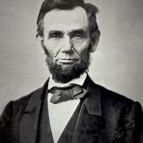
The sixteenth president of the United States, Abraham Lincoln (1809–65) was born in Kentucky and studied law in Illinois, earning the nickname “Honest Abe” for his upright moral character. In 1858, he ran for US Senate against Stephen A. Douglas, catapulting him to national fame even though he lost the race. He was elected to the presidency in 1860, just before the Civil War began. Lincoln did not accept the secession of the Confederacy, declaring the states to be in a state of rebellion. Assassinated in 1865, Lincoln would be remembered as a great wartime leader who was deeply devoted to maintaining the national union. His Gettysburg Address of 1863 is one of the most quoted speeches in American history.
Abraham Lincoln (1809–65) gave this speech to the Young Men’s Lyceum of Springfield, Illinois on “The Perpetuation of Our Political Institutions,” in which he articulated the need for a “political religion” to secure “the attachment of the People” to the Republic.
The final version of Lincoln’s Emancipation Proclamation took effect on January 1, 1863. The document declares that, “all persons held as slaves . . . are, and henceforward shall be set free.”
After his U.S. Senate defeat to Democrat Stephen A. Douglas in January 1859, Lincoln began considering a presidential run. Invited to speak in New York City by the clergyman Henry Ward Beecher (1813–87), Lincoln began drafting one of the longest and most important speeches of his political career.
On July 6, 1852, at the Statehouse in Springfield, Abraham Lincoln delivered a stirring eulogy for the Kentucky Senator Henry Clay (1777–1852), who Lincoln regarded as his “beau ideal of a statesman.”
On October 16, 1854, Lincoln and Stephen A. Douglas delivered competing speeches in Peoria, Illinois. While not a direct rebuttal of Douglas, Lincoln’s remarks (here excerpted) attacked the morality of slavery’s extension and of slavery itself.
On November 6, 1860, Abraham Lincoln was elected the 16th president of the United States. He was the first president from the Republican Party. Upon embarking on his inaugural journey from Springfield, Illinois, to Washington, DC, Lincoln paid tribute to his friends with a short impromptu speech on February 11, 1861.
The First Inaugural Address was delivered on March 4, 1861, ten days after Abraham Lincoln’s arrival in Washington, DC. Several southern states had already seceded from the Union, and Jefferson Davis (1808–89) had been inaugurated as the president of the Confederacy just two weeks before.
Abraham Lincoln’s most famous defense of equality appears in the Gettysburg Address, delivered on November 19, 1863, in the midst of a civil war whose deepest cause was the institution of slavery. Here Lincoln revisits the Declaration of Independence, summoning the nation to achieve a “new birth of freedom” through renewed dedication to the founding proposition of human equality.
On November 19, 1863, President Abraham Lincoln (1809–65) delivered his most memorable speech at a ceremony dedicating the cemetery for the Union dead at Gettysburg, Pennsylvania, site of the great victory in July of that year which marked a turning point in the Civil War. Lincoln used the occasion to offer his interpretation of the war and the reasons for which it was being fought.
On June 16, 1858 Abraham Lincoln was chosen as the Illinois Republican Party’s candidate for the U.S. Senate, running against Democrat Stephen A. Douglas. Upon receiving the nomination, Lincoln delivered these remarks to his Republican colleagues in the Hall of Representatives.
On April 11, 1865, just two days after Confederate General Robert E. Lee’s (1807–70) army surrendered, Lincoln delivered his last public address from the White House balcony. In his remarks, he noted the difficulties in moving forward with Reconstruction, but also expressed hope that the majority of white southerners would support efforts to reunify the nation.
This public letter, dated June 12, 1863, responds to a group of New York Democrats who, while professing loyalty to the Union, had criticized President Lincoln for the arrest of Ohio Congressman Clement Vallandigham (1820–1871), leader of the antiwar Democrats, known as the Copperheads (named after the venomous snake).
Less well known than his letter to Mrs. Bixby, a grieving mother, is this painfully beautiful letter of condolence that President Abraham Lincoln (1809–65) wrote to a teenage girl, Fanny McCullough, the daughter of an old friend from Illinois who had been killed in action.
Lincoln describes his frontier origins, his selection as captain in the Black Hawk War (an 1832 conflict between Illinois and Michigan settlers and the Native Americans), his legal and political career in Springfield, and his return to political life, spurred by the crisis over slavery’s expansion into the Western territories. He ends with a humorous and self-deprecating description of his ungainly physical appearance.
This letter has gone down in Lincoln lore, yet its origins remain cloudy. To start, it appears that the Mrs. Bixby in question did not actually lose all five of her sons in battle. It was first printed in the Boston Transcript, but no legitimate copy of it survives in Lincoln’s handwriting.
Following the surrender of Fort Sumter, Lincoln initiated a number of military measures. He called up the militia, instituted a blockade of Southern ports, and suspended the writ of habeas corpus. He also convened Congress to meet in extra session on July 4, 1861, where he outlined the events that started the war and defended his actions.
In August 1862, Horace Greeley, a Lincoln supporter and abolitionist, published an editorial in his newspaper, the New York Tribune, in the form of an open letter to the president. Lincoln wrote this reply to Greeley, also published in the Tribune, while a draft of the Emancipation Proclamation already lay in his desk drawer.
Abraham Lincoln (1809–65), who presided over the successful prosecution of the Civil War, also gave deep thought to the war’s cause, meaning, and purpose, and also to what would be required to heal the nation after the war was over. Here, in his Second Inaugural Address (March 4, 1865), invoking theological speculation and quoting Scripture, Lincoln offers an interpretation of the meaning of the war, which enables him to summon all Americans to a new and more difficult public purpose.
On the anniversary of George Washington’s birth, February 22, 1861—after he had been elected President but before he was inaugurated (March 4), and before the Confederate firing on Fort Sumter that began the Civil War (April 12)—Abraham Lincoln (1809–65) delivered this impromptu address at Independence Hall in Philadelphia, site of the signing of the Declaration of Independence.
On August 22, 1864, Lincoln delivered this address to the war-weary soldiers of the 166th Ohio Regiment. With the presidential election fast approaching, Lincoln saw the need to both express his gratitude to the soldiers for their personal sacrifice, and to remind them of the purpose and importance of the war.
Abraham Lincoln (1809–65) issued this proclamation for a day of national thanksgiving in 1863, in the midst of the Civil War, not long after the battle of Gettysburg and several other Union successes seemed to have turned the tide toward a Union victory. Like so many of his famous speeches, this modest presidential proclamation displays the extraordinary understanding, statesmanship, and generosity of soul that distinguished the 16th President of the United States.
One of Lincoln’s earliest published speeches, the Lyceum Address was delivered when Lincoln was just 28 years old and newly arrived in Springfield, Illinois. A little-known lawyer serving as a state representative, Lincoln spoke before a gathering of young men and women on January 27, 1838 about “the perpetuation of our political institutions.”