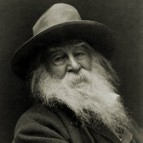
Famed American poet Walt Whitman (1819–92) was born to a working-class family on Long Island. Though he left school at the age of eleven, Whitman continued to educate himself. He worked as both a journalist and a teacher to support himself. Whitman was in his thirties when he published his first book of poetry, Leaves of Grass (1855). Praise from Ralph Waldo Emerson garnered attention for the book. Continually updated and reprinted throughout his life, Leaves of Grass went through seven printings between 1855 and 1892. Much of Whitman’s poetry discussed what it meant to be an American and lauded the American ideals of democracy, progress, and freedom.
Walt Whitman
Many of our poets have celebrated America’s ideals of freedom, equality, and democracy, but none have done so with greater zeal and effusiveness than Walt Whitman (1819–92). This short but dense tribute was first published in 1888 in the New York Herald, and reprinted later that year in Sands at Seventy, the annex to Whitman’s Leaves of Grass.
Walt Whitman
Born on Long Island, New York, Walter “Walt” Whitman (1819–92) worked at various times as a journalist, a teacher, a government clerk, and, during the Civil War, a volunteer nurse in Washington, DC. This version of “I Hear America Singing,” in which Whitman explores both the individual and collective nature of work, is taken from the 1867 edition of Leaves of Grass; an earlier version appeared in the 1860 edition.
Walt Whitman
In the days after Lincoln’s assassination, the nation, already war-torn and weary, grieved for its fallen hero. Devastated by Lincoln’s death, Whitman wrote one of his most famous poems—and the only one with rhyming meter.
Walt Whitman
As in “The Artilleryman’s Vision,” in this selection by Walt Whitman, published in Sequel to Drum-Taps (1865), a veteran speaks about his remembrances of war, this time as they fill his dreams. Of what precisely does he dream?
Walt Whitman
The Columbian spirits of exploration, adventure, and enterprise in pursuit of gain have continued to play major roles in America’s development and material progress, most especially in the 19th century: the conquest of the prairie, the settling of the West, the taming of the wilderness, the gold rush, and the mastery of nature through science, industry, and technology.
Walt Whitman
In this 1874 poem, American poet Walt Whitman (1819–92) imagines Columbus ashore in the New World (perhaps after his fourth voyage). He is sick, miserable, and close to death, hence eager for communion with God. How does Whitman’s Columbus, in his final prayer to God, allot responsibility for his own deeds and accomplishments? For what, if anything, does Columbus claim credit for himself?
Walt Whitman
This 1865 poem by Walt Whitman dwells not on concrete details of battlefield experience remembered, but on larger philosophical and religious themes of purification, reconciliation, and redemption.
Walt Whitman
In September 1861, five months after the Confederates fired on Fort Sumter, Walter “Walt” Whitman (1819–1892) published his poem “Beat! Beat! Drums!” in Harper’s Weekly, urging Americans to take up the cause of the Union and join the war. The following year, he received news that his brother George was wounded in the Battle of Fredericksburg, and the poet set off to find him. Though his brother’s wounds were minor, Whitman was profoundly affected by his interactions with the wounded soldiers, and for much of the war he served as a volunteer nurse in Washington, DC.
Walt Whitman
In this poem by Walt Whitman (1819–92), an aged veteran recalls for a Civil War volunteer—and for us—General George Washington’s Brooklyn campaign (and defeat) in the Revolutionary War. It was published in Drum-Taps (1865).
Walt Whitman
This story by the celebrated poet and essayist, Walt Whitman (1819–92), continues our exploration of the theme of remembrance. Written in 1842, at a time when the longest-living veterans of the War for Independence were fast disappearing, it supports its call for a duty to remember by presenting the narrator’s dream, experienced on one July 4th, of meeting—some 30 years into the future—“the last of the sacred army” of the Revolution.
Walt Whitman
In 1865, Walt Whitman (1819–92), already well known for Leaves of Grass (1855), published Drum-Taps, a collection of Civil War poems, several of which—including this one—served as a rallying cry for the Union cause.
Walt Whitman
Although “O Captain! My Captain!” is the more famous of Walt Whitman’s eulogies of Lincoln, the poet (1819–92) himself preferred this elegy to the fallen president.
