Materials Included | Begin by reading Jack London’s “To Build a Fire” on our site or in your copy of What So Proudly We Hail.
Materials for this guide include background information about the author and discussion questions to enhance your understanding and stimulate conversation about the story. In addition, the guide includes a series of short video discussions about the story, conducted by William Schambra (Hudson Institute) with the editors of the anthology. These seminars help capture the experience of high-level discourse as participants interact and elicit meaning from a classic American text. These videos are meant to raise additional questions and augment discussion, not replace it.
Learning Objectives | Students will be able to:
Explore the strengths and weaknesses of American individualism and independence by considering Jack London’s “To Build a Fire” in relation to the principles enunciated in the Declaration of Independence;
Read closely to determine what the text says explicitly and to make logical inferences from it
Cite specific textual evidence when writing or speaking to support conclusions drawn from the text
Determine central ideas or themes of a text and analyze their development
Summarize the key supporting details and ideas
Analyze how and why individuals, events, and ideas develop and interact over the course of a text
Interpret words and phrases as they are used in a text, including determining technical, connotative, and figurative meanings, and analyze how specific word choices shape meaning or tone
Delineate and evaluate the argument and specific claims in a text, including the validity of the reasoning and the relevance and sufficiency of the evidence
Analyze how two or more texts address similar themes or topics to build knowledge or to compare the approaches the authors take.
Writing Prompts
Is the man in “To Build a Fire” recognizably or typically American? After reading the story, write an explanatory essay that addresses the question and analyzes traits that you would consider to be typically American, providing examples to clarify your analysis. What conclusions or implications can you draw?
What is, and what should be, our attitude toward the natural world, especially if nature is indifferent to human beings and often hostile to our purposes? After reading “To Build a Fire,” write an essay that addresses the question and support your position with evidence from the text.
Is the man a hero or a fool?—or something else? What if he had made it back to camp? After reading “To Build a Fire,” write an essay that discusses your view of the man and evaluates his actions. Be sure to support your position with evidence from the text.
About the Author
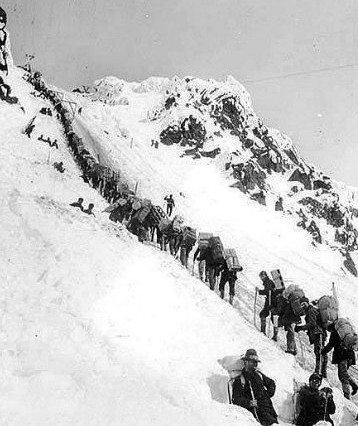
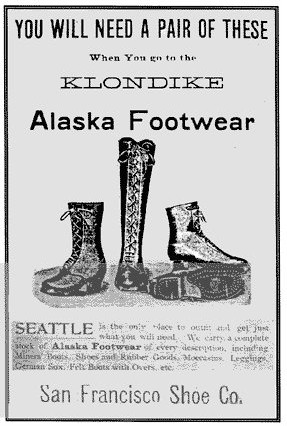
Jack London, like the unnamed man in this story, lived on the edge. Born in 1876, he died a short forty years later. As a young man, he was a full-fledged participant in the Yukon Gold Rush of 1897. Like many others at the time, London made the incredibly arduous journey by foot and handcrafted boat from Dyea in Alaska over Chilkoot Pass—a three-quarter-mile 45-degree-angled obstacle course—and eventually down the Yukon River into the Northwest Territories. The only gold he brought back, however, was an experience that he would mine for gems of literature for much of his writing life, as evidenced in his well-known novels like Call of the Wild and White Fang, as well as in “To Build a Fire” (1908), all of which draw on the places he saw and the people he met during those hope-filled and brutal times in the Northwestern Yukon territory.
The story is set in the depth of winter in the Northwest Territories, a place profoundly inhospitable to human beings. The plot is straightforward: On a single, sunless day, an unnamed man undertakes a nine-hour walk along a faint and little-traveled trail in brutally cold weather—75 degrees below zero, 107 degrees of frost. Bound for the mining camp, where his companions are waiting, he takes a roundabout way so that he can scope out the “possibilities of getting out logs in the spring from the islands in the Yukon” (2). Save for the clothes he wears, a watch, his lunch, some chewing tobacco, some matches, and a few pieces of birch bark, he takes precious little with him. He is, however, accompanied by a husky, who seems far more impressed and depressed by—and instinctively aware of—the “tremendous cold” (3). He starts his trek at 9:00 a.m., pauses at 10:00, arrives at his lunch destination at 12:30 p.m.—exactly the time he had set for himself—builds a fire, eats, takes a leisurely smoke, and resumes walking, aiming to make camp by 6:00 p.m. But suddenly, “it happened” (7): he accidentally steps into an icy spring. To dry off, he successfully builds another fire, but he does so under a “fully freighted” tree, whose boughs soon capsize their loads of snow and snuff the fire out (9). Despite the frost that has already affected his fingers, he valiantly attempts to build a third fire, but, alas, he fails. He then makes a couple of attempts to run before deciding to meet death “decently,” “with dignity” (14). He sits down and slips into a frozen sleep, watched over by the increasingly bewildered dog, who eventually wanders off and presumably makes his way back to camp.
Section Overview
Citizens from many nations, for quite different reasons, sought to penetrate the Northwest Territories. We can imagine, for example, a story like London’s about a French Jesuit priest losing his life while trudging through the Northern winter for the purpose of baptizing a newborn Huron Indian. We would be invited by such a tale to admire or even be inspired by the deep piety, the sacrificial spirituality, of such a Frenchman. We also have an historical British example in Sir John Franklin, who set out in 1845 with 129 men and two amply stocked ships to find the Northwest Passage, a route through the Arctic from the Atlantic to the Pacific Ocean. Although his expedition failed and all aboard were lost, Franklin stood for many decades as a proud symbol of British naval prowess and national, even imperial, honor. Noble impulses, like piety and honor, still inspire. But Jack London’s anonymous adventurer is out on the Yukon River, all alone in the dead of winter, searching for a profitable business opportunity: Jack London’s man is clearly an American. So are the story’s larger themes. But before getting to them, we need to look carefully at the protagonist of the story: his character, his deeds, and his purposes. We will also want to decide what we think of him.
A. The Man
How would you characterize London’s protagonist, “the man”? What do you know about him (1–2)?
Compare the man and the dog (3). How do they differ?
Look at pages 7–9. The man knows how to build a fire. What does this tell us about him?
The narrator says: “The trouble with him was that he was without imagination. He was quick and alert in the things of life, but only in the things, and not in the significances” (2). What does this mean? Is it inevitably a problem?
Is this man recognizably American? Typically American? Why or why not?
What is the significance of the fact that the man is not named?
Video Excerpt 1
WATCH: Who is “the man”? Is the man typically American?
Video Excerpt 2
WATCH: Why is the man nameless?
B. The Man’s Surroundings
Characterize the man’s surroundings (see 1–2). Where is the story set? What is the scenery like?
Consider the images London uses to set the scene—for example, “the spittle crackled . . . in the air” (2); the “muzzle of ice held his lips so rigidly that he was unable to clear his chin when he expelled the [tobacco] juice” (3); “the cold of space smote the unprotected tip of the planet, and he, being on the unprotected tip, received the full force of the blow” (8). What kind of moods and feelings do these images create?
What attitude toward nature does the man display? Compare the man’s attitude in the first few pages of the story to his final moments.
What attitude toward nature do you, as reader, experience while reading this story?
C. The Man’s Motives and Purposes
Use evidence from the text to determine what motivates the man to act as he does. What drives him? Why is he out on such a cold day?
How do you explain the man’s seeming indifference to the cold (4)?
Trace the man’s changing attitude toward the old-timer from Sulphur Creek. Why does he resist the old man’s advice? Why does he acknowledge, as he lies dying, that the old man was right?
Given the opportunity to make this journey again, under similar circumstances, do you think he would take it? Or do you think he learned something of significance from this experience that would alter his behavior or attitudes in the future?
What do you learn from his experience?
D. Assessing the Man
What do you think of the man? Do you regard him as an admirable hero—independent, resourceful, rugged, and resilient? Or a reckless fool—proud, overconfident, unimaginative, and blind? As something in between? In some other way? Explain, using specific examples and evidence from the text.
Had he successfully made it back to camp, would your judgment of him differ? (Note: In an earlier version of the story by London, the man survives, although he suffers terribly from frostbite.)
What do you think of the man’s purposes? Are they less worthy than those of other adventurers? Why, or why not?
What do you think London thinks of his own protagonist?
Might the unforgiving, frigid environment that London depicts—an environment that seems altogether to resist human intentions—provide a clue?
Might London’s own stylistic devices—for example, his numerous repetitions of words like “cold,” “know,” “fire,” and so forth—provide a clue?
Is the man (or a failing of his character) responsible for what happens to him? Or is he just an unlucky victim of an accident (“It happened”)?
Is the man a tragic hero? Is the story an American tragedy?
Americans have traditionally been known for, and generally proud of, their independence and self-reliance, their freedom and individualism, their enterprising and adventurous spirit, their courage and endurance in grappling with the forces of nature, their success through science and technology in making the world a more hospitable place for human life. These national traits of character, long celebrated in stories of exploration, adventure, the settling of the frontier, and the founding of industries are in fact encouraged by the American creed as it emerges through our founding principles and documents. So, for example, the Declaration of Independence conceives of human beings as free-standing, independent individuals, and it asserts that each of us has an inalienable right to pursue our own happiness, as each judges best. The United States Constitution established a large commercial republic, largely in the belief (defended in Federalist 10) that encouragement of material self-interest is far less threatening to stable and free government than is a politics dominated by zeal for high-minded opinion (be it religious, philosophical, or political) or a politics dominated by passionate attachment to charismatic leaders and ambitious men. The Constitution also embraced the goal of progress in natural science and the useful arts by calling for copyright and patent protection for authors and inventors. (Students and readers are encouraged to read these founding documents to better appreciate the questions that follow.) London’s story invites reflection on these features of the American character, with an eye to identifying and assessing their strengths and their weaknesses.
A. American Individualism
For these questions, consider the story in conjunction with the Declaration of Independence.
What are the strengths and weaknesses of the “rugged individual”? Of the self-reliant human being? Of the risk-taking individual? Give some examples of the rugged individual in literature, in movies, or in your own life. What do we admire about these people? What do we find lacking in them?
Could America have become what it is today without risk takers like London’s protagonist? Or is there a difference between him and the risk takers who tamed the wilderness and settled the frontier? If so, what is it?
Who are the risk takers in America today? Or do you think America is running out of risk takers? Does it matter? Is there any merit to the man’s risk taking, or is it simply foolish?
What does London’s story tell us about the strengths and weaknesses of American individualism? How might we correct for those weaknesses? Does London’s story have any advice for us?
Could London’s no-named man be any man from anywhere? Could any other country or culture produce him?
Video Excerpt 1
WATCH: What are the strengths and weaknesses of the “rugged individual”?
B. American Acquisitiveness and Enterprise
For these questions, consider the story in conjunction with the Federalist 10.
Are Americans more likely to be motivated by money than by other more exalted motives (e.g., religious piety, love of honor, or desire for fame)? Why or why not? If yes, should we be ashamed of this?
How should we judge people who undertake dangerous enterprises not from piety or the love of honor, but from a desire for wealth?
Some people claim that the American Republic is based on a “low but solid foundation,” namely, a foundation comprising self-interest, the love of gain, and a primary concern for material well-being. What might be the consequences—both good and bad—of this orientation for the morality and character of American citizens?
Video Excerpt 2
WATCH: The narrator says: “The trouble with him was that he was without imagination.” What does this mean? Is it inevitably a problem?
C. Science, Technology, and the Mastery of Nature
Are there limits to our efforts to control and tame nature? If so, what are they, and how can we discover them?
Does our reliance on science, with its emphasis on measurement and quantification of the appearances of things, blind us to certain deeper truths about nature and our relation to it? (Consider, in this regard, the strengths and weaknesses of living in the world guided by—as in the story—watches and thermometers.)
Can science and technology provide the wisdom needed for living with science and technology? If not, can we gain such wisdom from stories like this?
What is, and what should be, our attitude toward the natural world, especially if nature is indifferent to human beings and often hostile to our purposes? Who in the story is a better model, the man or the dog?
Is human life unavoidably tragic, technology or no technology (fire or no fire)?
What does the story teach us about death? The man realizes that he wants to “meet death with dignity” (as opposed to “running around like a chicken with its head cut off”) (14). What do we mean when we talk of meeting death with dignity?
Video Excerpt 3
WATCH: Are there limits to our efforts to tame nature and to have her do our bidding?



 (5 votes, average: 3.80 out of 5)
 Loading...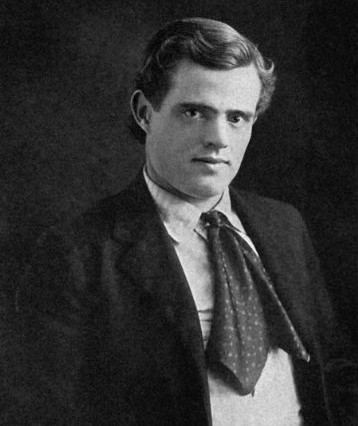
Post a Comment